
Welcome to Ultrafast Spectroscopy and Optoelectronics Lab (USOL)
RESEARCH
Exciton and Valley Physics in 2D TMDs
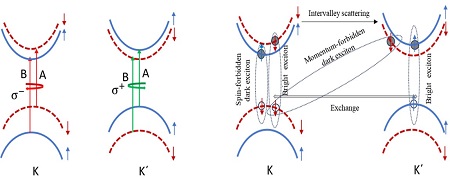
Two-dimensional transition metal dichalcogenides (2D TMDs) have emerged as an exceptional platform for exploring exciton and valley physics due to their atomically thin nature, strong quantum confinement, and reduced dielectric screening. These materials host tightly bound excitons with large binding energies and exhibit valley-selective optical selection rules arising from broken inversion symmetry and strong spin-orbit coupling. Our research focuses on understanding the ultrafast dynamics of excitons and valley polarization using femtosecond transient absorption spectroscopy. We investigate photoinduced carrier relaxation, intervalley scattering, exciton-exciton interactions, and spin-valley coupling in pristine, doped, and van der Waals heterostructures. Particular emphasis is placed on elucidating the mechanisms governing exciton dynamics and valley depolarization on femtosecond-to-picosecond timescales, providing fundamental insights into many-body interactions and nonequilibrium carrier dynamics. These studies contribute to the development of next-generation optoelectronic, valleytronic, and quantum technologies based on two-dimensional materials.
References:
1. Kamath, N. S. et al., J. Phys. Chem. Lett., 2026, 17, 25-38.
2. Anil, S. et al., Nano Lett., 2025, 25, 13401-13409.
Carrier and Spin Dynamics in Low-Dimensional MHPs
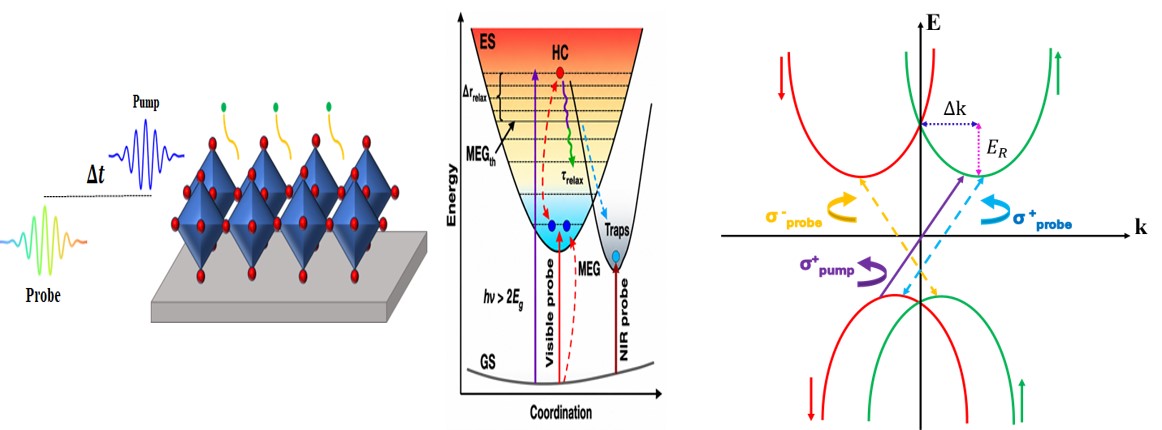
Low-dimensional metal halide perovskites (MHPs) have attracted significant attention as a new class of quantum materials due to their exceptional optoelectronic properties, strong excitonic effects, tunable band structures, and solution-processable fabrication. Their reduced dimensionality, combined with strong spin-orbit coupling and structural flexibility, provides a unique platform for exploring fundamental carrier and spin physics while enabling next-generation optoelectronic and spintronic technologies. Our research aims to uncover the fundamental mechanisms governing carrier and spin dynamics in two-dimensional (2D), quasi-2D, one-dimensional (1D), and chiral MHPs using ultrafast spectroscopic techniques. We investigate the generation, relaxation, transport, and recombination of photoexcited carriers on femtosecond to nanosecond timescales, with particular emphasis on the influence of quantum confinement, excitonic interactions, lattice dynamics, and many-body effects. A major aspect of our work is the study of spin-polarized excitons and charge carriers, where we explore the mechanisms governing spin generation, spin relaxation, and spin coherence. We examine how Rashba spin splitting, inversion symmetry breaking, chirality, and strong spin-orbit coupling influence spin-selective optical properties of MHPs. Understanding these microscopic processes is essential for development of high-performance perovskite-based solar cells, circularly polarized light emitters and detectors, and emerging quantum photonic and spintronic devices.
References:
1. Halder S. et al., Adv. Oppt. Mater , 2026, 14, 71508.
2. Sarkar, S. et al., arXiv preprint arXiv , 2025, , 2512.06773.
Quasiparticle Dynamics and Transport in Emerging Quantum Materials Probed by Ultrafast Optical Pump-Terahertz Probe (OPTP) Spectroscopy
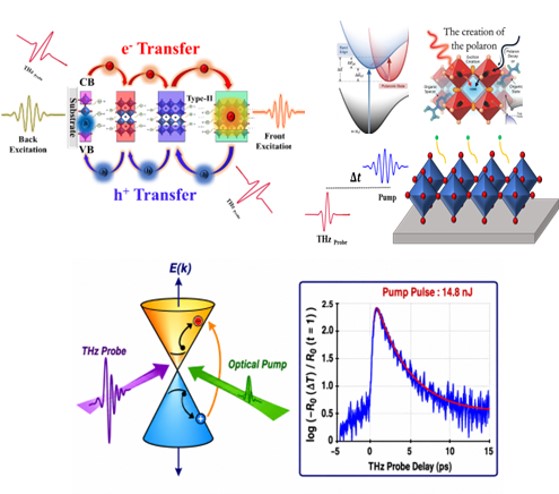
Ultrafast optical pump-terahertz probe (OPTP) spectroscopy provides a direct and contact-free approach to probing photoinduced carrier transfer and transport, transient conductivity, carrier mobility, and scattering dynamics on femtosecond-to-picosecond timescales. Our research focuses on understanding quasiparticle dynamics, carrier transfer, and charge transport in low-dimensional metal halide perovskites (MHPs), with particular emphasis on how quantum confinement, phase distribution, band alignment, and structural engineering govern the generation, relaxation, transfer, localization, and transport of photoexcited carriers. A major focus is to investigate the ultrafast evolution of photoexcited quasiparticles and their transition from excited states to mobile charge carriers. Using OPTP spectroscopy, we study carrier transfer between different phases and interfaces, transient photoconductivity, carrier mobility, carrier scattering, localization, and recombination, providing insights into the microscopic mechanisms governing charge transport in low-dimensional materials. Moreover, we aim to understand ultrafast quasiparticle, charge, spin, and lattice dynamics in magnetic and topological quantum materials using time-resolved terahertz spectroscopy. Our goal is to uncover and control nonequilibrium quantum phenomena relevant to future ultrafast spintronic and terahertz technologies.
Perovskite Materials for Advanced Device Applications
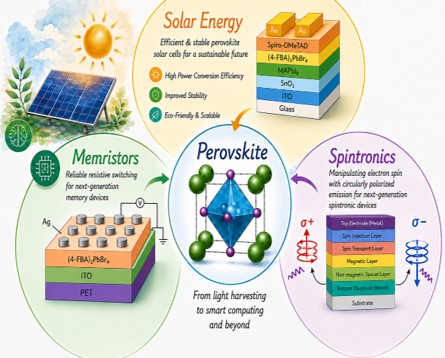
Metal halide perovskites have emerged as promising next-generation functional materials owing to their outstanding optoelectronic properties, including strong light absorption, tunable bandgaps, efficient charge transport, and long carrier diffusion lengths. Our research group focuses on developing novel perovskite compositions and interface engineering strategies for improving performance as well as environmental stability of perovskite solar cells. We are developing perovskite based indoor photovoltaics to make use of room lights. Beyond photovoltaics, we investigate perovskite-based resistive switching devices, exploiting their mixed ionic-electronic transport, mobile ionic defects, and defect-mediated ion migration to develop emerging non-volatile memory and computing applications. We study their neuromorphic characteristics, including short-term and long-term memory and in-memory computing, to explore their potential for brain-inspired computing systems. In addition, we investigate the spin-dependent properties of perovskites, enabled by their strong spin-orbit coupling, with the aim of developing perovskite-based materials and devices for next-generation spintronic applications.
References:
1. Kundar M. et al., RRL , 2023, 7, 2300572.
2. Gayen, K. et al., ACS Appl. Electron. Mater , 2025, 7, 10341-10351.